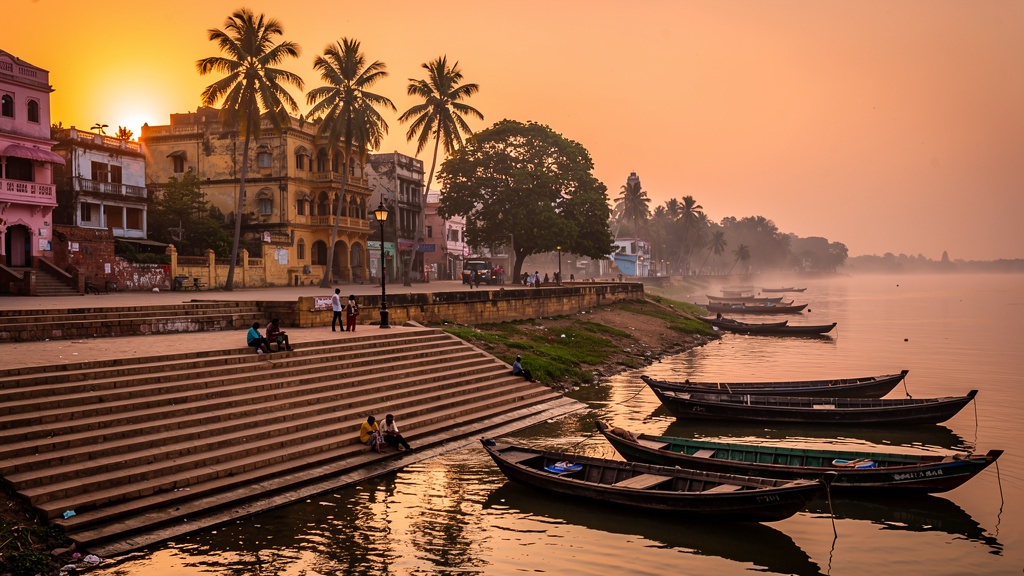
Hooghly River ghat at sunset - Uttarpara

About Uttarpara

Discover the story of a historic riverside town that has shaped Bengal's intellectual, cultural, and industrial heritage.

Uttarpara: A Town of Firsts

Uttarpara (officially Uttarpara-Kotrung) is a historic town on the west bank of the Hooghly River in the Hooghly district of West Bengal. Part of the Kolkata metropolitan area, it lies about 10–18 km from central Kolkata and has been a witness to over 300 years of Bengal's evolving history.

The town's name derives from its location — "Uttar" meaning north and "para" meaning locality in Bengali. Originally a cluster of fishing villages, it rose to prominence in the 19th century under the visionary leadership of the Mukherjee family, particularly Joykrishna Mukherjee, a pioneering zamindar, philanthropist, and moderniser.

Today, Uttarpara is a unique blend of colonial-era architecture, living heritage, industrial legacy, and everyday Bengali life — a place where the past coexists with the present, away from the tourist crowds.
Historical Timeline

Key moments that shaped Uttarpara's journey through the centuries.

~1704

Early Settlement

The area that becomes Uttarpara is established as a cluster of riverside settlements along the Hooghly, primarily inhabited by fishermen and farmers.

Early 1800s

Rise of the Mukherjee Family

The Mukherjee family, originally from the nearby village, gains prominence as zamindars (landed gentry) under the British East India Company. Joykrishna Mukherjee emerges as a key figure in the region's development.

1853

Municipality Established

Uttarpara becomes one of the oldest municipalities in West Bengal, marking its formal recognition as an urban settlement. This is also the year the Howrah–Bardhaman railway line reaches the town.

1859

Jaykrishna Public Library Founded

Joykrishna Mukherjee establishes the Jaykrishna (Joykrishna) Public Library — widely recognised as the first free public library in India and Asia. It becomes a centre of Bengali Renaissance thought and intellectual discourse.

Late 1800s

Rajbari & Temple Construction

The Mukherjee family builds the grand Uttarpara Rajbari (zamindar mansion). The Pancharatna terracotta temple and Bhadrakali Temple are also constructed or renovated during this period.

1909

Sri Aurobindo's Uttarpara Speech

After his acquittal in the Alipore Bomb Case, Sri Aurobindo delivers his famous Uttarpara Speech at the library, outlining his vision of India's spiritual destiny — one of the most significant speeches of the independence movement.

1942

Hindustan Motors Established

Hindustan Motors sets up India's first automobile manufacturing plant in Uttarpara. The factory begins producing the iconic Ambassador car in 1949 — a car that becomes synonymous with India's roads for over six decades.

2014–Present

Industrial Transition

Hindustan Motors ceases Ambassador production in 2014. The factory site is later acquired by Titagarh Rail Systems for modern metro-coach manufacturing, marking a new chapter in the town's industrial story.

Key Figures in Uttarpara's History

Joykrishna Mukherjee

Born 1808, Joykrishna Mukherjee was a visionary zamindar, philanthropist, and moderniser. He founded the Jaykrishna Public Library in 1859 and was instrumental in developing Uttarpara's civic infrastructure, including roads, schools, and the municipality.

Sri Aurobindo

The spiritual philosopher and revolutionary leader delivered his seminal Uttarpara Speech at the library in 1909. This speech marked a turning point in his life, where he articulated his vision of India's spiritual mission to the world.

Michael Madhusudan Dutt

The great Bengali poet and playwright is known to have visited and used the library's collection. His association with Uttarpara's intellectual circles adds to the town's literary significance.

Uttarpara Today

Today's Uttarpara is a living, breathing town that honours its past while embracing the future. The library continues to serve the community, the Rajbari stands as a monument to zamindari grandeur, and the riverfront remains a beloved gathering place for residents and visitors alike.

The town has a strong Durga Puja tradition, with notable community pandals drawing visitors during the festival season. Local markets bustle with activity, and authentic Bengali food is readily available at eateries that have served generations.

While not a polished tourist destination, Uttarpara rewards the curious traveller with genuine experiences — conversations with library staff, the sight of a train passing over the river bridge, a quiet moment at the ghat, and the taste of freshly made mishti doi.

1853 Municipality Founded
1859 Oldest Public Library (Asia)
~225,000 Population (2023)
3+ Centuries of History